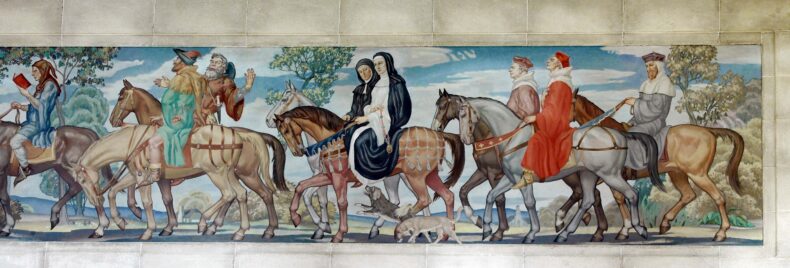
Did you ever have to memorize the prologue to The Canterbury Tales? I did, for high school English class, spring semester of senior year. I was cranky about it—why do we have to recite this stuff?—but as with most things I didn’t want to learn, I’m glad I did. Every springtime I think of the opening lines: “Whan that Aprill with his shoures soote…” For anybody who hasn’t read it (or hasn’t read it in a while), the prologue explains that it’s April, sweet showers have ended the misery of winter, flowers are blooming, birds are singing, and people long to go on pilgrimages to give thanks for surviving the winter. The pilgrims meet up on their road trip to Canterbury and share their tales. (Kind of like we do on this group blog, The Last Word on Nothing.)
I was trying to remember the lines of the Prologue the other day while biking along the Potomac River (as well as the lines to Forgetfulness, a poem about forgetting poems). I stopped at a cliff face to watch a pair of peregrine falcons fighting with a pair of ravens for control of a nest. The ravens built the nest a few years ago, the peregrines stole it, and the ravens were now trying to take it back. The peregrines won. I also saw an eagle on a nest and another peregrine near the Harper’s Ferry nesting site. (If you want to see peregrines on a nest, a third site, near Point of Rocks along the C&O Canal, is a short walk upstream from the parking area. Look for all the photographers and birders.)
I’m so grateful. Grateful that we survived the winter. Grateful that peregrine falcons and bald eagles survived DDT. Those pilgrims in the Canterbury Tales were looking for adventure and fellowship, sure, but they were also expressing their gratitude. In their case, they were making a pilgrimage to the shrine of Thomas Becket, the Archbishop of Canterbury who was martyred in 1170 by King Henry II’s knights and became a saint.
It’s such a human impulse, to give thanks for things that feel miraculous. Those of us who aren’t religious don’t have the same shrines, rituals, or regularly scheduled fellowship, but we do have secular saints, people who made the world better or saved our lives. We don’t pray to them, exactly, but it’s inspiring to remember them, appreciate them. I would gladly light a candle and leave an offering at a shrine to Saint Rachel of Carson.
Secular saints don’t have to be dead. They don’t have to be perfect (religious saints weren’t). And they don’t have to work alone. When it comes to surviving the winter, it’s important to recognize that the best biomedical research is interdisciplinary, iterative, international, and highly collaborative. But it’s so human to pick out a few people to represent the whole, to sanctify. We want to give thanks to those “that hem hath holpen whan that they were seeke.” So thanks to secular saints like Katalin Karikó and Kizzmekia Corbett for covid vaccines. To Jonas Salk, of course. To Robert Bullard and everyone who has worked for environmental justice. To people who contributed to AIDS drugs, statins, cancer trials, the Framingham heart study.
Science has plenty of secular saints. Marie Curie, in addition to all her discoveries, trained more than 45 women and changed the course of science. (She didn’t necessarily aim to hire women in her lab; she simply didn’t discriminate against them.) Albert Einstein could be non-religiously canonized for his peace and social justice work (again, they don’t have to be perfect). The Galápagos Islands sort of feel like shrine to Charles Darwin.
Pop culture has saints. R&B singer Ruth Brown fought the music industry for cheating artists out of their earnings, and she used her win to establish the Rhythm and Blues Foundation to support other musicians. (If you’re not already listening to Andrew Hickey’s A History of Rock Music in 500 Songs, Brown’s is a good episode to start with.) There’s Nina Simone. Jim Henson (although I wish the Muppets had started out with better female representation than Miss Piggy, Janice in the band, and Gonzo’s love-interest chickens).
History is full of secular saints, especially people who fought injustice. Harriet Tubman, John Brown (speaking of Harper’s Ferry), Mary Wollstonecraft, Nelson Mandela. Magnus Hirschfeld established the world’s first transgender health clinic, whose library was destroyed by the Nazis in their first book burning. (Transphobes have always been on the wrong side of history.) Cleve Jones created the AIDS Memorial Quilt, the holiest secular shrine. Stanislav Petrov refused to start a nuclear World War III.
I could go on and on, and I bet you could, too. Who are some of your favorite secular saints? What people might you say a little prayer to if you were the praying type? Whose good works give you hope and courage?

Thank you.
With ‘everything’ so horrible these days, this was an excellent reminder to celebrate those who have enriched our lives.
Climate scientist James Hansen leaps to mind.
John McCain: I disagreed with him utterly on all things political. But his courage as a POW, and his refusal to leave without his fellow prisoners . . . I can’t wrap my head around that level of courage.
Ursula LeGuin, for the unassuming nurturing wisdom embodied in her essays and fiction.
Bill Mollison, who created permaculture.
As a group, everyone who ever participated in Team in Training, to raise funds for cancer research.
Antonio Gaudi, for demonstrating that architecture can be playful. Even religious architecture.
Rep. John Lewis, for being John Lewis.
Man. This could go on for days.
I enjoyed this article so much and I’d definitely have Jane Goodall and Carl Sagan on my own list of secular saints.