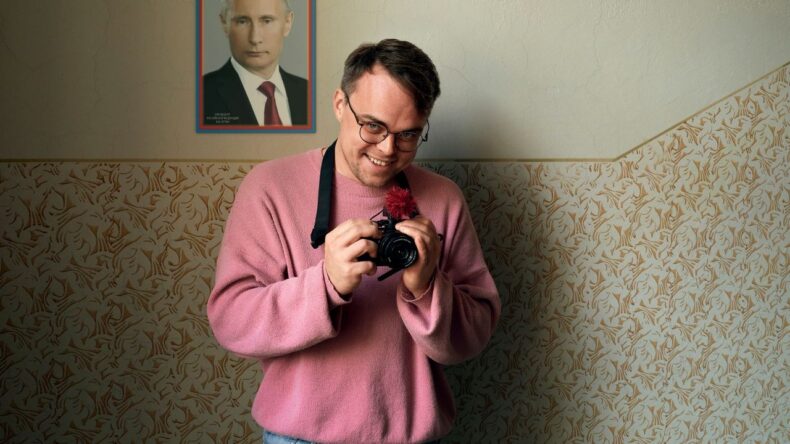
In May of 2025, I went to Mountainfilm in Telluride with my BFF Rosemerry Wahtola Trommer. We watched numerous amazing films, but there’s one that continues to haunt me, eight months later.
Mr. Nobody Against Putin is a documentary filmed by Pavel (Pasha) Talankin. Here’s the synopsis published in the festival guide:
Pasha is a beloved teacher and event organizer at a small Russian school. In ordinary times, he is a mentor, prankster and nonconformist, known for hanging up democracy posters and offering his office as a safe haven for students who feel left out. However, after the 2022 invasion of Ukraine began, his responsibilities began to include facilitating daily state-sponsored propaganda events. Under the guise of his actual role as the school’s videographer, he documents footage inside classrooms, chronicling an institution abruptly transformed by new regressive laws, militarization, violence and oppression.
At the time we watched the film, we were only four months into this current administration and it felt like the world was crashing down. Rosemerry and I were similarly terrified and heartbroken by the destruction we were witnessing in our country, but we had polar opposite responses to the film. She was energized by it. I was left feeling even more despondent.
A few days later, I called her to talk about the film.
Christie: We saw this film called Mr. Nobody Against Putin. How would you describe it?
Rosemerry: So in this film, Pasha is a beloved school teacher in the Russian city of Karabash. He does videography in his school, and he’s been doing this for years. He’s quirky. He’s funny.
Christie: We fall in love with him from the beginning. He so clearly loves his students.
Rosemerry: And then very quickly in the movie, Russia begins this invasion of Ukraine. And Pasha documents the changes in the school where he’s teaching.
Christie: It’s a school for students from grade school through high school and Pasha’s job is to organize and videotape school events and happenings. This film is created with footage that he filmed as part of his job.
Rosemerry: We get to really see how the school becomes militarized. The teachers are forced to read propaganda about the war.
Christie: And the kids are forced to recite propaganda. They begin doing military exercises in school.
Rosemerry: The soldiers start coming in and passing around things like machine guns and landmines.
Christie: The kids start wearing military garb and singing military songs. It’s shocking.
Rosemerry: It’s so sad. The movie itself is terrifying and sad for multiple reasons. One, it’s terrifying to see what’s happening there in Russia. And two, it’s terrifying to see just how closely it resembles some of what I see happening here.
Christie: It was terrifying to recognize how much of this is happening in the U.S. right now. The outlawing of certain words, the banning of certain subjects in schools, the false narratives being pushed out by the administration and, in particular, the fealty being demanded by the current POTUS.
Rosemerry: So why did I walk out of the theater excited?
Christie: I really want to know, because I left the theater with a deep feeling of despair and resignation. Pasha had to leave his country to release the film. He is not safe, and his friends and family may be in danger.
Rosemerry: I was so profoundly moved by this teacher’s courage. He was an everyman, right? I mean, it’s in the title, Mr. Nobody. He’s nobody.
Just like me just like you — right? Who are we in the scheme of things? As I look at what’s happening in our country and around the world, how often do I think to myself, oh well what can I do? I’m just one person.
Christie: This is really interesting, because I had initially read the title of the film differently. My interpretation was that it was saying, nope, nobody here is against Putin. Nothing here to see, move along. Like he’s trying to fend off the authorities while he’s also defying them.
Rosemerry: Interesting. I really took it like a nobody, like you, like me, just Joe Blow Citizen, shows up and says, I’m going to stand up against one of the most powerful men in the world.
Christie: I was very moved by Pasha’s courage. He acts out. He informs the students that their teachers are being forced to read these propaganda statements. He removes a flag that was flying at the school and puts a peace flag up in his classroom.
Rosemerry: The fact that he was able to do that made me think wow Rosemerry, you you have a voice. You have a platform. You have the ability to speak out, to speak up.
Christie: I certainly felt that too. That there’s power in one person’s defiance.
Rosemerry: Here’s the other thing: he was not only speaking out against what Putin was doing, but he was showing up for integrity, showing up for peace, showing up for democracy and that thrilled me. He wasn’t just against something. He was really showing this is what I’m for.
Christie: To me, that was the most powerful aspect of the film. He wasn’t shouting or getting in peoples faces. He was just peacefully acting according to his values. He was standing up for truth.
At the same time, I see the steep price he’s paid, and how little effect his resistance has had on his community. After the Mountainfilm screening, Pasha appeared (via video) to answer questions, and he did so from an undisclosed location, because he’s not safe.
Rosemerry: During that Q&A, he shared that the people in his community wondered when he would come back and ask forgiveness — that that’s the message that he’s getting right now. When will you come back and ask forgiveness for this thing that you’ve done, as opposed to thank you.
Christie: Yeah, if people in his community are grateful for what he did to resist, they’re not talking. Of course it may be because they can’t, we don’t know.
Rosemerry: Right, how would they be able to say that?
Christie: What we see in the film is that this propaganda is quite effective. He had many former students who were apparently willingly signing up to become soldiers for this war. They were not deterred, or at least not enough to find an alternative. Some of his former students are killed in the war, and it is not permissible to talk about it. That detail crushed me. People in his town are rallying for the war and seemed quite quite willing to support it. And that’s something we’re seeing here, too. We have this fascist movement and people are waving their flags for it. Demonstrable lies are being spread by the administration and people not only believe them, but argue for them. So Rosemerry, why so hopeful?
Rosemerry: The film itself doesn’t make a difference. What makes a difference is the people who watch the film and then say, oh my gosh, look at that. He did what he could. And now I’m going to stand up and do what I can. Right? It’s so common right now to feel utterly demoralized, helpless, hopeless. And how do you counteract that? You counteract that with one person’s courage. And now you’ve got two people.
Christie: I recognize that my feelings here are maybe more a reflection of where I’m at as a journalist than of the film itself.
I have this overwhelming feeling that so many of us are doing all the things. I spent most of the first administration reporting for a high profile news organization on the ways that norms were being bent and broken. And what difference did it make? A lot of great journalists are doing outstanding work right now, and it’s being disappeared by the algorithms and we have all these media outlets capitulating to the administration and being transformed into propaganda arms. Public media is getting defunded.
Rosemerry: What thrilled me about this film was one person, one nobody, standing up and saying, I’m going to do something. What can I do? What did he know how to do? Make video. That’s what he knew how to do. So he told the story the way he knew how.
Christie: I feel that. I also feel, as someone who’s spent a lot of time doing what I knew how to do, which is journalism, well, this isn’t a fair fight. I came away from this film feeling really downtrodden because I feel so deeply for Pasha and his community. Here’s someone who’s doing this brave thing at enormous risk to himself. He had to leave his country.
One of the things that really comes through in the film is that Pasha is someone who belongs to a place, and that place is Karabash. He introduces it as a toxic, industrial town and shows all the pollution and the grimness of the place. And that’s followed by this scene where he gushes about all the things he loves about the town. I mean, what you see is that above all, this guy loves his place. He loves this community. He loves his students. If he had a choice, he would stay there. And now he’s banished. He’s not going to be able to go back. It’s not safe for him. And his family may be at risk too.
So he’s made this amazing film. And we gathered in Telluride, in beautiful place among a lot of wealthy people that attend the festival. We all watched it and had all the feels.
But how how how is this going to get Putin out? How is this going to change the situation? How do we stop it? Every film buff in America could could watch this film. They could even get riled up and talk about it. But how is that going to stop Putin?
***
I recorded the conversation above between Rosemerry and me in May. I had intended to publish it here, but it didn’t have any kind of satisfactory resolution. I just felt extremely uneasy about it, so I tabled it.
And now it’s January 2026, and everything feels so much worse than it did a year ago. The stakes feel higher than ever. ICE agents have just murdered two protestors in Minneapolis and the city is being occupied by violent agents from its own country.
I have spent a lot of time calling my Congressional House Representative about many different issues over the last 12 months. I have almost nothing to show for it. To justify his vote to take health care away from vulnerable people in his district, my Representative, Jeff Hurd, told the local paper that they were cutting money from Medicaid to protect Medicaid. It’s doublespeak straight out of Orwell’s 1984.
At times, fighting this has felt like bashing your head against a brick wall, but I’m starting to find reasons for hope. The SCOTUS might still be relinquishing unchecked power to the executive branch, but the courts are still working (albeit slowly) in many cases. Some powerful people are refusing to acquiesce. Millions of people attended the No Kings rallies last year. At some point, our voices will be too loud to silence.
My friend Frank posted a video of his Minneapolis neighborhood singing in peaceful protest over the weekend, and I felt genuine hope. Other Minneapolis friends are sharing stories of neighbors helping the most vulnerable in their community. I think of the poetry that Rosemerry and other poets like Amanda Gorman and Kate Horowitz are writing in resistance.
A year into this nightmare, I still understand why I felt so dispirited by Pasha’s story. Bad things are happening. Boldface lies are being put forth as official policy in Russia and in the U.S, and people who fight back face retaliation. People are speaking up and resisting and yet the bad things continue to happen.
But I’m in agreement with Rosemerry that our focus must stay on the long game. When I start to feel despair, I remind myself we can’t give in to it. The future has not yet happened. We can still make a difference. Very soon, we will reach critical mass. One person disputing the lie may not make a difference, but millions of one persons can.
Postscript: Pavel Talankin is shortlisted for an Oscar!
Image: KinoLorber.com

I’m with you, Christie, on the despair. Only lately have I begun to understand what Rosemerry is talking about, the idea of finding what we are *for*. I appreciate these two responses to the film.
I also found the movie very depressing. And I love your final paragraph.
Separately, and sort of related: Have you read The Sunflower Boys by Sam Wachman? I recommend it.
I haven’t read The Sunflower Boys, thanks for the recommendation Lila.
I am trying so hard to stay hopeful, but it’s hard when it feels like the efforts just disappear into a black box.
Dear Christie
I am reading now “the black sun: the alchemy and art of darkness” by Stanton marlan. I find it extremely interesting and helpful as the power we have is one of awareness (very difficult) and one of transmutation (even more difficult). As the old world is collapsing and getting very loud as it does, we have the choice of turning inside and transforming the part of the world we carry. We can dream the new world. One of justice and equality and freedom. One where we respect each other and all sentient beings. One where war doesn’t interest anyone anymore, so nobody gives it energy. In the meantime there’s a lot of shadow projections.
The other book that I found tremendously helpful (and not an easy reading) is by jungian analyst and homeopath Edward Whitmont “the return of the goddess” where he describes what we’re seeing 42 years in advance.
I hope this little sharing will help you as I can hear your heart being so burdened by so much darkness, just like mine is.
Take good care
Carpe diem
Great Post!