I am lately returned from Punta Tombo, the Magellanic penguin breeding colony in Argentina where I spend several weeks each year. One of my tasks there is to open the field season in late October, which means I spend a lot of the early days stumping around our designated study areas looking for study penguins. Over the years we have marked many thousands, but they come and go. Some die at sea during the austral winter, some decide not to breed in a given year, some change nests, and so on. The start of a season therefore basically amounts to an exercise in accounting, as we peer into burrows or under bushes to see who is where and whether or not we know them.
By the time I arrive, the penguins have been at the colony for a month or so. Males start to arrive in mid-September to establish or reclaim territories. Females come a couple of weeks later and soon lay their clutch of two eggs, after which the males leave for what we call the long incubation foraging trip. This trip can last a couple of weeks or more. In most cases when we find a study bird, then, it is a female sitting on her eggs alone, her mate being off at sea. But the sex ratio at Punta Tombo is heavily skewed towards males; there might be three or four for every female. This means many males who never got a mate are still hanging around.
Bachelor males, as we think of them, react to their predicament in different ways. They might solicit copulations from every single female that toddles across their visual plane. Many get into fights with other bachelors, brawling until they are soaked with blood. A few basically force themselves into a nest with a female and in effect pretend to be her mate, while she sits on her eggs and stares at him balefully; we call these males home invaders. Others, curiously, will sit on a rock as if it were an egg.
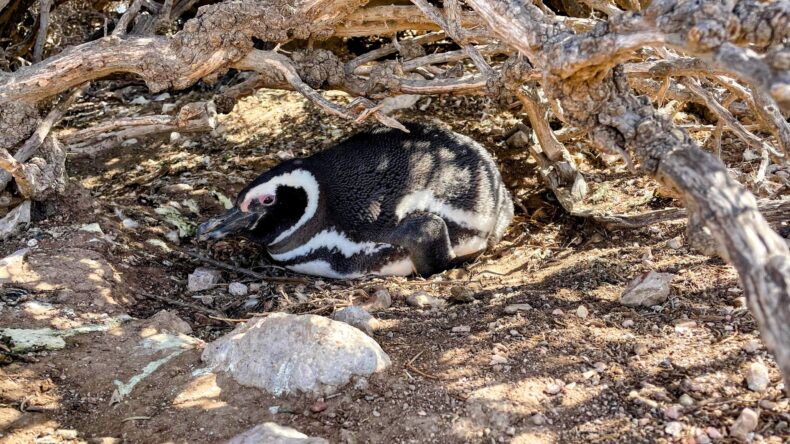
One male in a study area was incubating an especially large white rock—much larger than any penguin egg could ever be. We saw him every day in his nest under a bush, dutifully tending to his rock. He was not a study bird, but he was such a character that he became known to us, in part because his nest was near where we liked to deposit excess gear. Eventually we named him Rock. “Good morning, Rock,” we would say. “Keep fighting the good fight.” Rock would wag his head back and forth at us, which is what penguins do when they want you to leave them alone.
Anyway, the weeks passed and I left Punta Tombo near the end of the November, just as the chicks were starting to hatch. Leaving is always tough. For a time I have immersed myself so deeply in the penguins’ quotidian but urgent cares. Will the male in nest 511D return from his foraging trip in time to relieve his mate, before she gets so hungry that she abandons their eggs? What about the pair in W06R? Their nest isn’t the best. Will one of them step away to get a drink and lose their eggs to a kelp gull? Will a strong rainstorm sweep in and flood the colony, destroying nests and washing away scores of eggs? Will there be a toxic algal bloom that will kill hundreds of adults, like there was last December? Because at the root, the question is always: Did the penguins survive the night, given that their lives are so hard?
Suddenly I am no longer in a position to know any of that, and I have to resist the desire to write the field crew and beg that they tell me everything about every penguin everywhere every day. But usually after about a week I have calmed down enough to return to the more abstract care I feel when I am not at the colony. In this way the season sort of freezes in amber. In my mind, now that I am gone, all the eggs will hatch, all the chicks will be fine, there will be no storms, no toxic algal blooms, no marauding pumas, and plenty of fish in the sea.
A few days later I was floating along in that precarious state of magical thinking when I received a message from Meredith, a graduate student still down at Tombo.
You remember Rock the penguin under that tree who was faithfully brooding a rock for the longest time
The chick from 508S was being bullied and somehow climbed out and found Rock
Who is brooding the chick now
He even moved the rock aside
Meredith included a photo. It showed Rock staring defiantly at the viewer. Sticking out from between his feet were the downy hindquarters of the chick from nest 508S. I was shocked. I could think of maybe two or three instances in the last forty years where adult penguins adopted chicks not their own. In those instances the adopters had been established pairs. Never a single male. Saint Rock, I thought. He will be Saint Rock now.
I sent back a host of questions: Did this chick hatch first or second? How old was it? Was there a significant weight disparity between it and its sibling? How long had it been with Saint Rock? My working theory from afar was the chick was not getting enough food and in its blind, searching stumbling had somehow managed to cross a few yards of open ground without getting eaten to reach Saint Rock, who had taken the chick in. But had he fed the chick? That would be the real, true sign of adoption. Meredith wrote that the chick was indeed the second in the brood, and so smaller of the two. It wasn’t devastatingly skinny, but it was thin, and it had some small injuries from being pecked. As for whether Saint Rock had given the chick food, she didn’t know.
Looking more closely at the picture, I saw that the chick’s down did appear a little careworn and its hips maybe more prominent than you would like. In that moment I was yanked back to the colony, hearing all the sounds, smelling all the scents. I wasn’t sure if I had the wherewithal to keep asking the field crew for updates, to follow the story to its end, to learn the chick’s fate or the extent of Saint Rock’s beneficence. Most likely he would not feed the chick and it would eventually starve and die, like so many chicks do every year. But you never know.
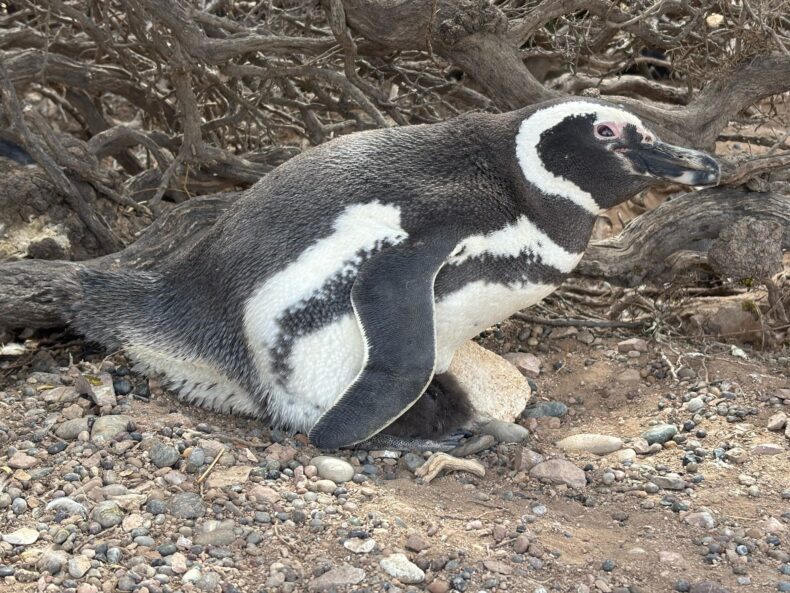
Top photo by the author, bottom photo by Meredith Honig
