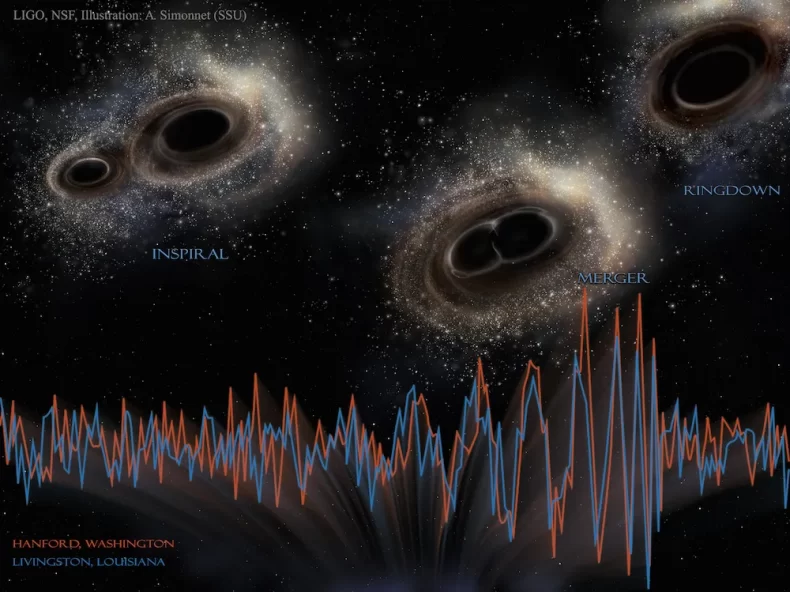
I thought the latest sound clip from two merging black holes was nice but I’d heard this before and I wasn’t stunned. You can hear them spiraling in toward each other and merging — I can’t hear the ringdown which I assume is the merged entity shuddering. The first time I heard one of these clips, though, was the first one (above) recorded, ten years ago, and I was stunned to pieces; I even made it my ring tone. My ring tone clip:
My phone would ring, I’d explain happily to people who heard it that it was the sound equivalent — astronomers call it a chirp — of the gravitational waves caused by two black holes merging. People were generally polite about it.
The translation from gravity to sound by some thoughtful geek was natural: gravitational waves are pressure waves in space/time, just as sound is pressure waves in air. I like my old ring tone clip better than the latest clip — pretty sure the difference is just that the audio was stretched out to play longer, or something — because the inspiral and ringdown were clearer. Inspiral, ringdown, and chirp really are the technical astronomical terms, isn’t that nice, you don’t even need them explained.
Then I got a new phone with a new ring tone and forgot about it all.
I forgot it until the latest black hole merger and its chirp, its inspiral and ringdown (goodness but I love those words), reminded me of a thing astronomers like, which is data sonification. Which is a short but overly fancy way of saying “translation from one kind of wave to another.” I mean, gravity, sound, light, they’re all just waves. They all have frequencies (how many waves in a given space) and amplitudes (how high the waves are). This gets way more complicated* fast, and the only thing I can keep track of is that frequency in light means color — blues are high frequency, reds are low — and in sound it means pitch, high and low. And amplitude in light means brightness; and in sound, it means loudness. So to my simple mind, you can sonify the sky by translating the blue stuff to high pitches, the red stuff to low pitches, and the bright stuff to loud sound and the dim stuff to quietness.
Like this: https://youtu.be/FznGTdMMe7g. Sort of. It’s a star named Eta Carinae, erupting into two lobes shining in optical frequencies (medium pitch), rotating and making coming-and-going wow sounds; then the lobes glow in ultraviolet (high pitch), then some red (low), and then in xrays (really high). You can definitely hear Eta Carinae. This gets more complicated fast too, partly because in the video, the frequencies are shown separately but the star is shining in all of them all at once. So that would mean you wouldn’t hear those sequential lows and highs, but a chord.
That complication is particularly lovely: sound happens in time (light does too but too fast for our slow human brains). That is, simultaneous sounds are chords, but otherwise sound moves in time, like music. So another way to sonify light is to play a sort of radar-sweep through the image, like this: https://youtu.be/crlR66jZutU.
It’s the center of our galaxy, bright stuff is loud, dim stuff is soft, and lots of gas that sounds like low hums and stars that sound like twinkles. The loud bright thing on the far right is the stuff surrounding the galaxy’s central black hole. (For reasons I don’t understand but probably ought to figure out, in the sonification the pitch goes from high at the top of the image to low at the bottom.)
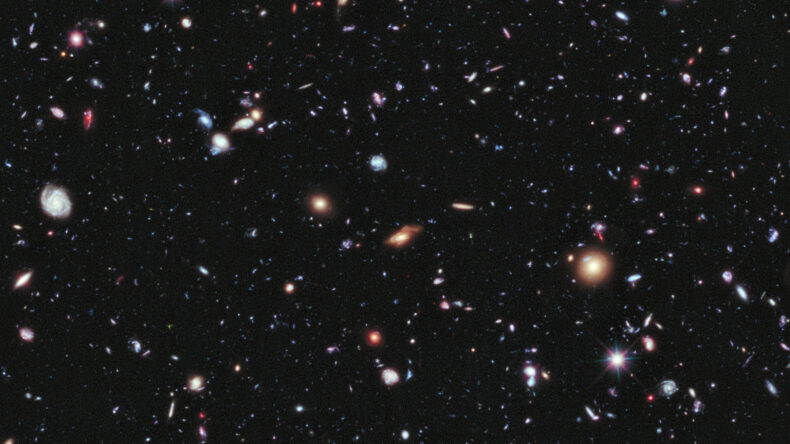
Astronomers actually use sonification partly to get a different perspective on the image, a different feel for what the data is telling them. But honestly, I understand that perspective only through this particular sonification of the Hubble Ultra Deep Field, an image got by opening up the camera on the Hubble on a dark speck and leaving it open until all its galaxies show up. Here you go: https://svs.gsfc.nasa.gov/13893.
In this sonification, the brightness (and size) = loudness as usual, but the image is moving through time with the sound. That is — and follow me closely here because this is a little shattering — as the sound moves in time, the image’s stars and galaxies ping in. First the nearby stars and galaxies ping in, then ones farther away, then farther yet.
And the longer the sound moves, the more galaxies show up and the the louder the sound and the farther away the galaxies. That is, because distance in space is distance in time (and now I’m having trouble not writing in all caps), the longer the sound moves and the louder it is, the more galaxies show up and the farther away they are and the older. These first few galaxy pings are a 1 billion years old, these are 2.75 billion, these louder ones are 6 billion, these are 11 billion years old — now it’s so loud, how are there so many galaxies? You can hear the universe running backward in time (really, really want to write in all caps now, really do).
And around 12 billion years old it starts getting quieter. And at 13.35, it’s silent, no more galaxies pinging in. This silence at the end of the sonification is THE SILENCE AT THE WHOLE ENTIRE COSMIC BEGINNING (oh goodness, I’m having trouble breathing). I’ll say it again: the silence at the end is the silence at the beginning. Once more: https://svs.gsfc.nasa.gov/13893.
__________
*Waves also have wavelengths (how long a wave is in a given space) which are always correlated with frequencies (long wavelengths = low frequencies), so in a way you need to stipulate only one and the other follows. And in fact, astronomers use “wavelength” and “frequency” idiosyncratically and I suspect, depending on the astronomer’s field. Just ignore all this.
_________
Merging black hole visualization: LIGO, NSF, Aurore Simonnet (Sonoma State U.)
My ring tone was from https://www.zedge.net/ringtones/7f09bbee-f089-4a61-9025-394b9449a724
Hubble Ultra Deep Field photo: Sonification credits: SYSTEM Sounds (M. Russo, A. Santaguida). AND MIND YOU, THIS IMAGE IS OVER 10 YEARS OLD, the current JWST image is even more crowded.

These sonifications* are more beautiful than they have a right to be. Thank you for sharing!
*This is my new favorite word.
Oh thank you! I was pretty sure that not many people would share my delight so I’m glad you did
I love this so much Ann!
Oh WOW. That last one of the universe aging backward through time, and then it all GOES QUIET. I cannot.
Me either.