My last post in July was about a court case in New York state where a judge decided a dog who had been killed by a negligent driver could be considered “immediate family” under the law, enabling the family to seek damages beyond the monetary value of the dog.
One of the things I find fascinating about cases like this is you can watch the legal system—which is inflexible by nature—grapple in real time with changing societal norms. And I’m equally fascinated by how we think about and relate to other species, and how and why that has changed over time. So matters of animal law are of particular interest.
If these matters intrigue you as well, here are a few more recent legal cases involving our relationship with other animals.
California Court of Appeal denies the necessity defense on behalf of animals
This case gets at the question of who should decide whether animals matter under the law. In the New York case I wrote about, a judge saw it as his role to answer a legal question about when and how animals matter. The court in a recent California case saw things differently.
The case involves an animal rights activist who was charged in 2019 with trespass during protests at farms in Sonoma County, during which activists took sick chickens and ducks from the farms, got them veterinary care and brought them to live at animal sanctuaries. One of the activists charged was Wayne Hsiung, co-founder of an animal rights group called Direct Action Everywhere that has won similar cases in the past, including one that got a fair amount of press coverage involving two sick piglets rescued from a factory farm in Utah.
Hsiung, who is a lawyer, represented himself at a jury trial and asked to present a “necessity defense,” which is a doctrine excusing the breaking of a law in order to stop or prevent something worse, such as breaking a car window on a hot day to rescue a baby at risk of overheating. Hsiung pointed out that 14 states also allow citizens to break a car window to rescue a dog and argued that in his case, trespassing was necessary in order to prevent the more serious harm of animal cruelty, which represented a “significant evil” under the necessity doctrine.
The judge denied the request, saying that the necessity defense does not apply to harm to animals. The prosecution argued that in order to apply it to animals, the necessity defense would need to be expanded, which is the purview of lawmakers, not courts. In 2023 Hsuing was convicted of two counts of misdemeanor trespass and one count of felony conspiracy to trespass and sentenced to 90 days in jail, of which he served 38. He is currently appealing his conviction in the California Court of Appeals.
U.S. Supreme Court refuses, again, to overturn California’s Proposition 12
In 2018 Californians voted overwhelmingly (63 percent) to prohibit some of the most intensive methods of confining animals raised for meat or other products in California or sold in the state. The law requires more space for calves raised for veal, egg-laying chickens, and breeding pigs, and specifically bans gestation crates (metal enclosures too small for sows to even turn around, where they are kept for months while pregnant).
Since then, the meat industry has tried several times to stop or overturn the law. In 2021, the U.S. Supreme Court rejected an argument by the North American Meat Institute that Prop 12 violated the Commerce Clause of the Constitution, and the law went into effect in January 2022. In 2023, the Supreme Court again upheld the law, with a 5-4 decision against a challenge from the American Farm Bureau Federation and the National Pork Producers Council.
And in June of this year, the Court refused to hear an appeal brought by the Iowa Pork Producers Association for a case that had been dismissed by the 9th Circuit Court of Appeals.
Mexico adds protection for individual animals to its constitution
In December, Mexico made changes to its constitution that prohibit mistreatment of animals and directs the state to “guarantee the protection, proper treatment, conservation, and care of animals”; mandates that animal welfare be included in grade school and high school curricula; and requires the creation of a national law to protect animals—including farm animals.
As far as I can tell, that law has not yet been made, so the ultimate impact of these constitutional provisions remains to be seen. Still, Mexico’s move does seem to break some new ground. Though animals are recognized in a few country’s constitutions, it’s usually just as a part of nature rather than as individual beings, and mostly without any mention of their treatment. A few countries’ constitutions do address animal protection in a general way, including Switzerland (which was the first to include animals in 1973), India, Brazil, Slovenia, Germany, Luxembourg, Austria, Egypt, and most recently, Italy (in 2022). However, this inclusion has not necessarily resulted in any actual change in the treatment of animals in these countries.
But because Mexico’s constitutional provisions are more specific, it could have more impact. According to the provisions, when lawmakers do create the new legislation, they need to consider animals’ nature, characteristics and relationships with people.
Also in Mexico, in June, the Mexican Senate unanimously voted to ban dolphin and other marine mammal shows. In April the Congress of Mexico City amended its Civil Code to change the legal categorization of animals from things to sentient beings, which addresses an inconsistency with the city’s constitution which already recognized animals as sentient beings. Mexico City also recently banned the killing of bulls during bullfights and revised its animal welfare law to include “community” dogs and cats that are cared for by residents.
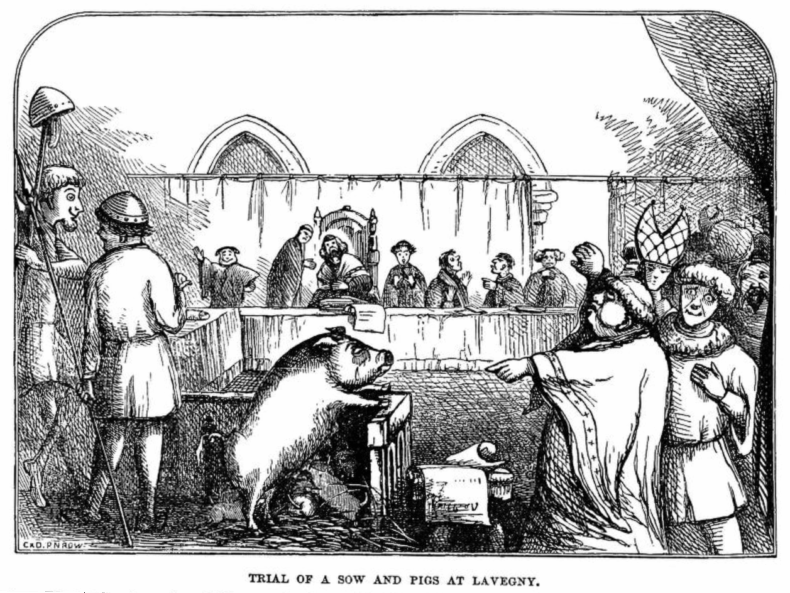
Image source: Robert Chambers, “The book of days, a miscellany of popular antiquities in connection with the calendar, including anecdote, biography, & history, curiosities of literature and oddities of human life and character” 1863. https://archive.org/details/cu31924014604627/page/128/mode/1up?view=theater

Betsy, thank you so much for pulling these threads together. It’s great to see even this Supreme Court uphold what Iowa Senator Chuck Grassley called California’s “war on breakfast.” A drive past the CAFOs in the Central Valley and elsewhere is enough to remind us there’s a long way to go.