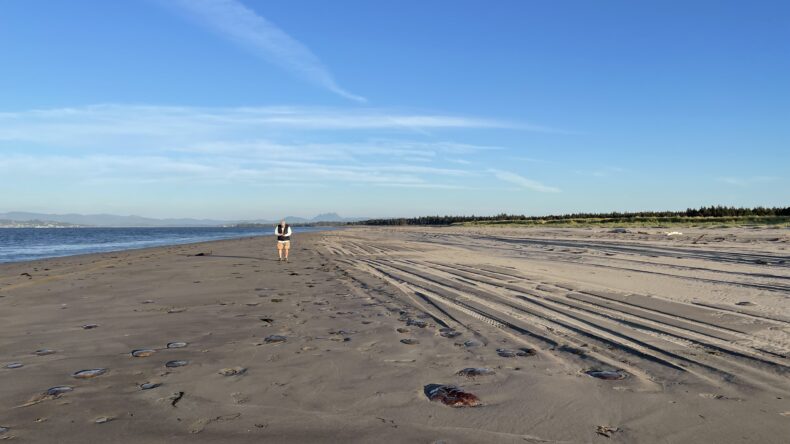
A couple of weeks ago I spent a long weekend with my dad in Astoria, the town in Oregon where I grew up. Our visits tend to go like so: On the first day I arrive in the late afternoon and we go for a walk, either at a beach or around the neighborhood. The second day we do some project around the house and then we go for a walk, almost always at a beach. Finally, on the last day, we get brunch at a coffee shop before I hit the road.
It was the evening of the second day, and we had decided to go to Clatsop Spit at Fort Stevens State Park, a few miles from Astoria. We parked and made our way through dunes and beachgrass to the beach. There we turned west, walking along soft wet sand.
Our progress was slow. It often is. My dad snaps pictures with his phone of whatever catches his fancy, which is almost everything. (“Doesn’t that beached sea nettle look like a nebula if you crop the image?”) I watch birds. Clatsop Spit marks the mouth of the Columbia River, and the river was roiled, this being where it and the Pacific meet. In that roil were scads of pelicans, gulls of various species, Caspian terns, cormorants, all of them pursuing small fish swimming out to sea. I watched the pelicans tip over and dive from the air, watched the terns do the same, both of them plunging into the water. I watched the gulls swim over and try to snatch meals from the pelicans and terns, or, to give them their due, catch fish on their own. As different sets of pelicans or terns or gulls ate to their hearts’ content, I watched them fly over to the beach to roost together in the warm brilliance of the setting sun.
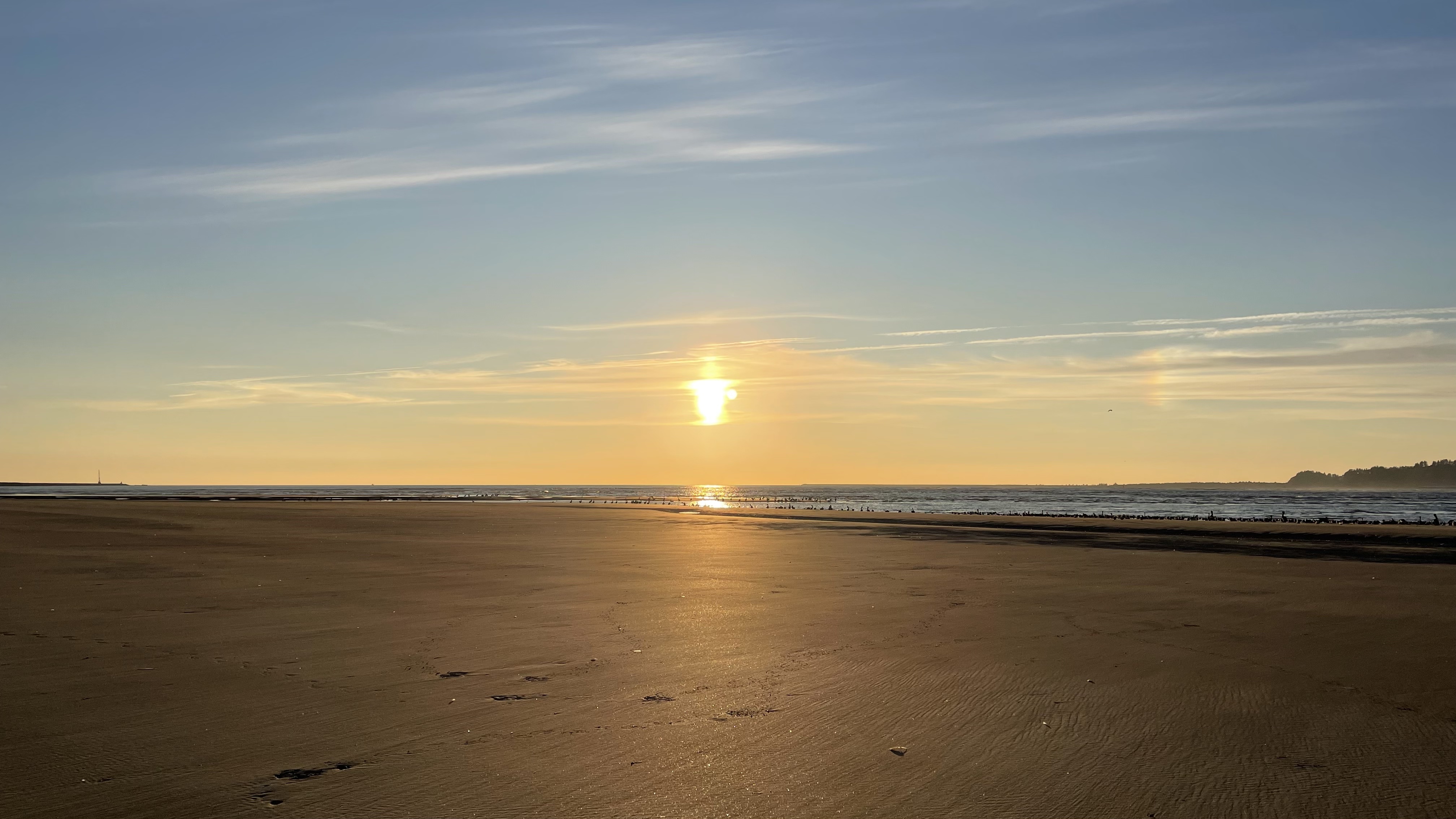
I let my binoculars trail over the beach throngs. Ah, it was heaven of a sort. Then my binoculars strayed over to a sign planted behind us at the boundary with dry sand. It forbade cars from driving in or around the dunes between March and September. This was to benefit snowy plovers, a diminutive shorebird that lays its eggs in sandy dimples and depends, unfortunately, on their remarkable camouflage to carry the day against the full range of human or human-facilitated depredations. The species is federally threatened, but is also a provisional conservation success story. After years of dedicated intervention, the population in Oregon is thought to number about seven hundred individuals, which is not a lot, but is still more than the thirty-five individuals counted in 1990.
I had never seen a snowy plover at Clatsop Spit, but not for lack of trying. I was trying again when a small SUV crossed into my binocular’s visual field. In place of the sand and drift logs and maybe-plovers was, jarringly, an enormous human head with eyes half-closed, blissed out to music or whatever as the vehicle crawled towards the birds on the shore. Thankfully the driver realized there were living beings in front of them and stopped. The birds, though restless, stayed put.
“I wish cars weren’t allowed on the beach,” I groused.
“Really?” my dad said. “I’m kind of glad they are.”
I all but gaped. My dad usually is not a car apologist.
He shrugged. “Without the cars, we probably wouldn’t be walking here,” he said.
Grumble. My dad spent his career as a photojournalist, first at the Daily Astorian, and then at the Daily News in Longview. He has an irritatingly granular knowledge of the region’s history and color and political nuances. Our discussions tend to go like so: I make a sweeping generalization that, in the idealized space of my mind, is so blindingly obvious that the fact it has not been widely accepted is essentially a crime. He listens for a while and then gently brings up some state law or local ordinance or reasoned consideration about why my generalization is impractical and even damaging for ninety or so reasons.
Here, what he brought up was the public nature of Oregon’s beaches. That people are allowed on the entire state coastline at all is due in part to Oswald West, who as governor in 1913 spurred the legislature to declare all of Oregon’s beaches to be public highways. (People needed to be able to drive, West argued.) The public took their general access for granted until 1966, when a hotel owner in Cannon Beach blocked off a portion of the dry sand and said his guests alone could use it. The 1913 legislation had a loophole, it turned out: The highway designation only covered wet sand. Some landowners had purchased parts of the dry sands. Here was one now willing to close it to the public. Would others? Oregonians who had thought of the beach as their beach whether wet sand or dry now feared developers would buy up the land and keep them from it—the same fear that had spurred the 1913 provision in the first place. But in 1967, Governor Tom McCall—a Republican who had gotten his start in television—championed and signed the Oregon Beach Bill. The bill not only preserved the wet sand public highway designation, but also added a zoning easement for the rest of the dry sand up to the vegetation line. The beaches were saved. The public rejoiced. But in the end, my dad said, if cars had not been allowed on the beaches, then we probably wouldn’t be allowed on the beaches, either.
In spite of me being solidly middle aged, debating a parent still brings out my inner recalcitrant teenager. “Well,” I said, maybe a little snottier than necessary, “I think it’s time they reconsider the whole cars thing.”
“I could see that,” my dad said. One of us at least had to show some grace.
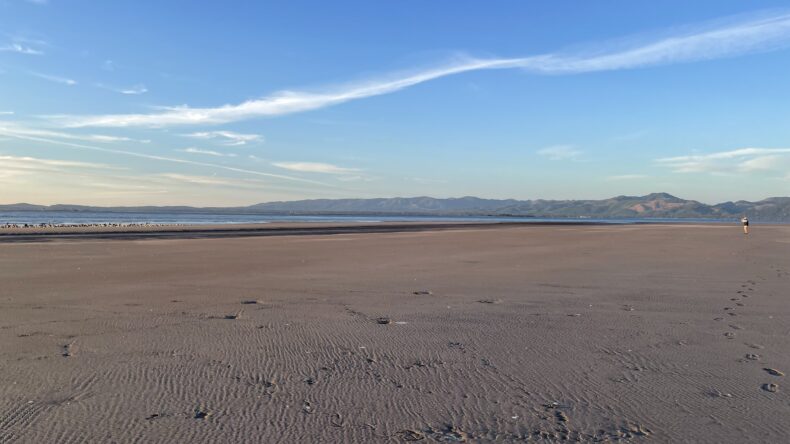
We went back to our slow stroll, he with his phone at the ready, me with my binoculars. I was again sweeping the flock because you just never know when I saw out of the corner of my eye a quick movement. The movement resolved into a being, small and sickle-shaped, flying low over sand. “Hey!” I yelled. “Hey! Hey! It’s a snowy plover!” I tracked it with my binoculars for a second or two, and then whipped out my phone and snapped a couple of pictures as the plover flew down to the wet sand, weaving and cutting, before it disappeared among the throng of larger, more stolid birds.
“Did you get it?” my dad asked.
“I think so,” I said, showing him my efforts. “You can kind of see it.”
My dad looked at the picture and winced. “You really ask a lot of your equipment sometimes,” he said.
I laughed and zoomed in on the plover-y blur. Yes, the picture was terrible, but I was also pleased with it, as I am with all my awful bird pictures. When I showed it off in the days to come, everyone else might see just three or four beige pixels, but I would know what I was looking at: a snowy plover at Clatsop Spit; or, a creature making the most of the compromises in this compromised space.
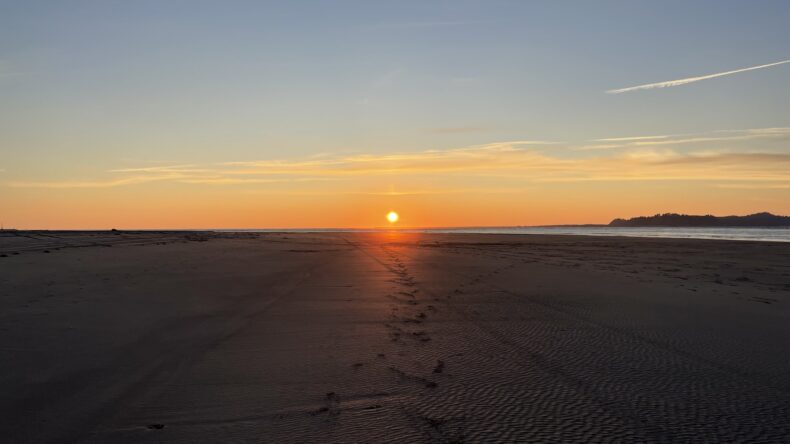
Photos by the author, of course

I too take great delight in all my blurry out-of-focus pictures of birds, even with a DSLR I rarely get one that isn’t, not unless they stay really still for me. I’ll add bats to that too, each one a black streak in the sky.
That’s great. We should have an exhibition sometime. Could call it “A Sky Full of Dots” or something.