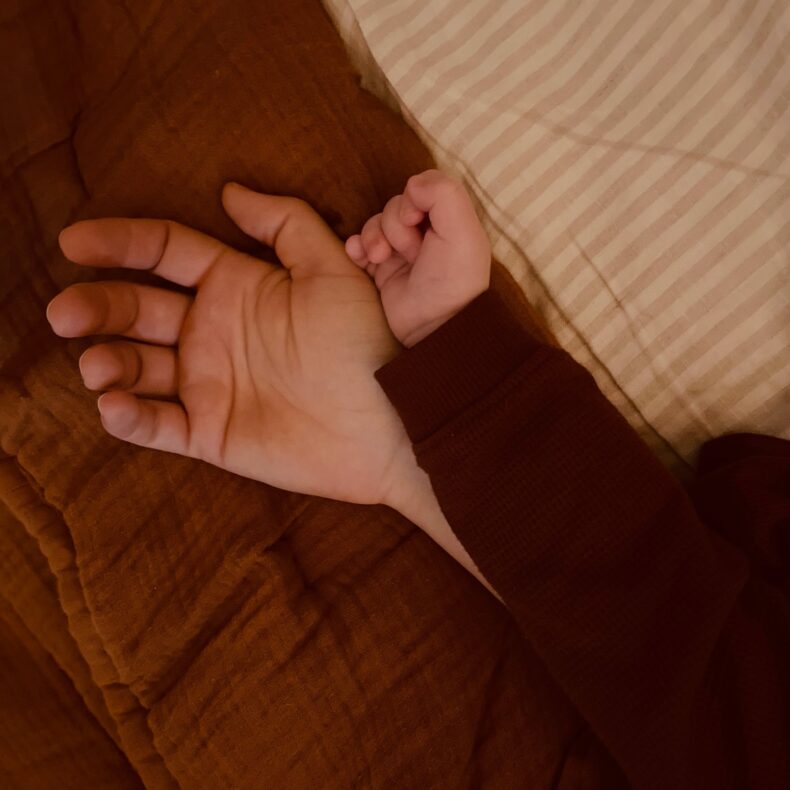
Our one-year-old strokes his hair when he’s tired, twirling his curls between his fingers. That’s how he puts himself to sleep — eyelids drooping, drooping, down.
Neuroscientists call this lazy, rhythmic caressing “slow touch” or “affective touch.” It moves across the skin at one to 10 centimeters per second — faster than a snail, slower than handwriting — and works best when it’s warm and focused on hairy skin, like the scalp or forearm. That’s where we and other mammals have the highest density of C-fibers: nerves specially tuned to respond to gentle, affectionate contact.
What fascinates me about C-fibers is their dual nature. In addition to a soft caress, these evolutionarily ancient, slow-conducting nerves are also responsible for carrying the sensation of a hot chili pepper, the itch from a poison oak rash, the hellfire of shingles.
C-fibers don’t have myelin, the fatty coating that helps other nerves send signals quickly. While faster, myelinated nerves deliver sharp, immediate pain — the kind you feel when you stub a toe — C-fibers handle the slower, more diffuse ache that lingers afterward. When they’re damaged or overly sensitive, C-fibers can trigger long-lasting, hard-to-treat pain conditions like allodynia, where even a hug or a pat on the back hurts, and clothing irritates the skin. But the opposing sensations C-fibers carry can also cancel each other out to some extent, which is why some researchers are exploring slow touch as a treatment for pain and itch.
At the right time, and from the right person, slow touch feels amazing. It helps newborns regulate their temperature and heart rhythms, and helps older children build a sense of “self,” where their own body ends and someone else’s begins. Not surprisingly, early experiences of slow touch can cast a long shadow, research suggests: people who were neglected or abused as children often find slow touch less pleasant than those who didn’t.
What a privilege — and responsibility — to help shape another person’s sense of touch, as a parent. When Will busts his lip or slams a finger in a drawer, I instinctively scoop him up and pet his hair and arms, trying to comfort him as best I can. I can’t stop him from falling (or even from climbing onto the kitchen table, apparently.) But the time we spend snuggling helps us both recover when it happens.
Meanwhile, Will is also learning how to use touch to show affection, although it’s often still painful on my end. (Did you know hair-pulling elicits one of the fastest known pain signals?) Although he isn’t talking clearly yet, he’s learning to communicate in a language embedded in our very nerves and universal among species. Its fundamental principle is simple but surprisingly difficult to master: You must pet — not grab! — the cat.

This reminds me of an experience I had in the middle of the COVID isolation. I had to have a blood test, and the nurse was telling me a story that tickled her so much, she fell lightly onto me. It gave me an amazingly warm and comforting feeling that I still remember. I don’t remember if she touched my arms, but it was certainly a soft, warm touch. It was also a vivid reminder of how important human connection is to us.
Thank you for sharing that, Gail. I think there’s a sense that for adults, touch is only or mostly about romantic connection, which can be isolating. even when we’re not in a pandemic lockdown. We need that kind of comfort from friends and pets, too!