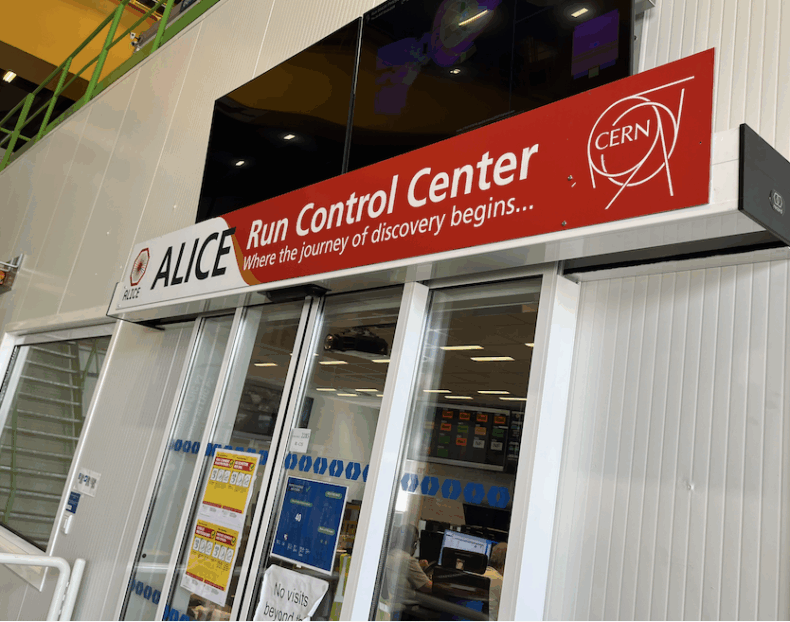
Earlier this month, I had the pleasure of visiting CERN (Conseil Européen pour la Recherche Nucléaire) with a group of STEM-curious high school kids. Our guide on the visit was Shirajum Monira, a tiny, dark-haired woman, who spoke gently as she walked us through numerous exhibits, experimental facilities and scientific devices. She spoke patiently and answered our questions in a way that showed a deep understanding of the science.
One of the places Monira took us was the Control Center for ALICE (A Large Ion Collider Experiment) at the LHC (Large Hadron Collider). The ALICE project is studying strongly interacting nuclear matter that was prevalent in the universe’s earliest moments. Monira clearly knew a lot about ALICE and when I asked her how she ended up as a tour guide, she explained that she’s a researcher on the project. (I would later learn, via an internet search, that she was part of a team that won the 2025 Breakthrough Prize in Fundamental Physics for their work with the LHC.)
When I expressed my surprise that someone of her professional stature would be spending their time giving student tours, she told me that she volunteered to speak to students in hopes that she might inspire them to see possibilities for themselves. When she was 15, the age of the students in my group, she didn’t know any physicists, and hadn’t seen anyone from her background working as a scientist.
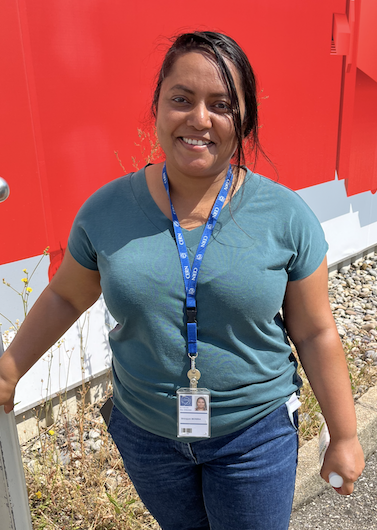
Monira is from Dhaka, Bangladesh, and she was working a job translating news from English to Bengali when she encountered a story about the LHC. She was so captivated that she moved to India to study physics. She wasn’t even sure if she would be good at physics, but she knew that she wanted to learn more. After getting undergraduate degrees in India, she went to Finland for graduate school and is now affiliated with a university in Poland and working at CERN. No one else in her family is a scientist, and she told me that her parents and family do not understand what she does or why she doesn’t want to move back home and focus on becoming a good wife and mother.
I consider the passion she must feel for physics, and the curiosity that drove her to shift course and pursue a life in science. This is the inquisitiveness that fuels scientific discovery. Science needs more Moniras, and ever since I met her, I have been imagining her encountering another budding scientist on one of the tours, someone whose life could be forever changed by seeing someone like themselves succeeding in this field. I think of my dad, the first in his family to go to college and how no one in his family understood or nurtured his interest in physics and astronomy. If meeting Monira could give even one kid the courage to follow their curiosity and pursue a dream that might seem weird or ridiculous to the people around them, Monira’s already substantial contribution to science would be magnified. Perhaps it’s already happened.
Last year, Monira won a special prize in the “Three Minute Thesis” competition, which challenges doctoral students to explain their research to a general audience in three minutes, without using slides or props. (In case you’re wondering, her talk was titled “Exploring the role of flavour in baryon production mechanism through angular correlations in proton-proton collisions at √s = 13.6 TeV with ALICE.”) Clearly, she knows how to translate complex science to the public. She has a brilliant future ahead.
Images by Christie Aschwanden
